
Previous aquarium setups
I have gone through quite a few tank setups over the years, so this page contains details of just a few of them.
I have mainly included setups which were different to the ones I currently have. They are also the ones from more
recent years, i.e. since I've had a digitial camera and could get some half decent pictures!
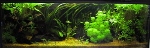
Planted S.E. Asian community tank
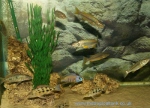
This setup was a planted tank setup using plants and community fish from South East Asia. I did a few different versions
of this setup, the longest one running for 3 years.
Apart from the plants, the main decor was bogwood. In the setup above, the background was Cornish slate attached to the back glass.
The substrate was a sand/nutrient substrate mix, topped with a layer of fine lime-free gravel. Filtration was provided by
an external canister filter and an internal power filter. Lighting was provided by 3 x 40W tubes, one on for 12 hours,
the other two for 10 hours - to give a less-bright dawn/dusk effect for the first and last hour.
The fish included 4 different species of loaches, several barb species, rasboras, gouramies, 'sharks' and siamese algae eaters -
not all at the same time! The plants included Vallisneria, Limnophila, Hygrophila, Cryptocoryne's for the front, and floating Indian Fern.
Malawi mbuna tank
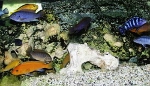
Surely one of the most colourful of freshwater setups, this setup was a rocky tank setup for the rock-dwelling cichlids
(mbuna) of Lake Malawi in East Africa. This is another type of setup where I did a few slightly different versions over the years.
The tank was set up with a rocky decor to provide plenty of caves, in order to mimic to some extent
the natural environment of mbuna, where there are no higher plants (just algae on the rocks). Ocean rock or
"Holey limestone" was the main rock used in the setup pictured above, though in other previous Malawi setups I have also
used slate, limestone and a local rock called Millstone Grit. The substrate shown above is crushed Alfagrog, a ceramic
filter material based on calcium carbonate.
As it is considered normal to overstock these particular cichlids to control aggression, the tank needed to be well
filtered. Strong circulation and aeration was provided by two powerheads with Hagen QuickFilter cartridges to provide
excellent mechanical filtration, and some back-up biofiltration via the media placed in the core of the cartridges.
The main biofiltration was provided by an external canister filter with a spray-bar return.
Tanganyika tank
This setup housed the other popular group of East African cichlids - those of Lake Tanganyika. This was the second larger
Tanganyikan-type setup that I had done, and I've usually had one display tank and a few smaller breeding tanks for Tanganyikan's
on the go at any one time. The setup above was based on a tank with a 48" x 18" base, which gave plenty of room for aquascaping.
The picture above shows the right-hand side of the tank.
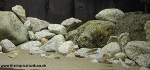
This tank was set up with a rocky decor to suit the Tanganyikan cichlids it housed. This consisted of 6 larger rounded boulders
and lots of smaller 'Glenmore' cobbles - both obtained from a garden centre. The rocks have been piled in a rubble-pile fashion, and
a scattering of shells added, to give a reasonable simulation of Lake Tanganyika's rocky habitats. A fine sand substrate was used.
The tank housed a number of different species during the time it was set up, some of which were moved to and from smaller breeding setups.
They included different 'Julies' (Julidochromis species), Altolamprologus calvus, various Neolamprologus and Synodontis catfish. A shoal of
Cyprichromis leptosoma livened up the open area at the top.
The tank was filtered by a Fluval 304 filter which had a broken pump head. Water was therefore forced through the canister by a Rio 1100 powerhead (322 Imp GPH)
with a Hagen QuickFilter cartridge attached, which provided excellent mechanical pre-filtration. There was also a large airstone for extra aeration
and circulation.
Back to Tank Setups